
Taking the operator out of the cab
On a 40-ton Sennebogen material handler, we built a remote control system precise enough for real material handling — and turned it into the first step toward autonomy.
Scarce expertise, locked into a single cab
Running a material handler has always meant putting a skilled person in the cab, on site, in whatever the job demands, scrap yards, demolition sites, timber terminals, inland ports, with dust, noise, vibration and hours of physical strain. That constraint has become one of the industry’s tightest bottlenecks: skilled operators are scarce and expensive, and tying one of them to a single physical machine wastes their expertise and limits how flexibly a fleet can be scheduled.
The reflex answer is automation. But jumping straight to full autonomy is too risky and too unproven for safety-critical heavy machinery. No operator, site manager or insurer is ready to accept it today. What the industry needs is a credible path there, not a leap.
Remote control with real depth perception
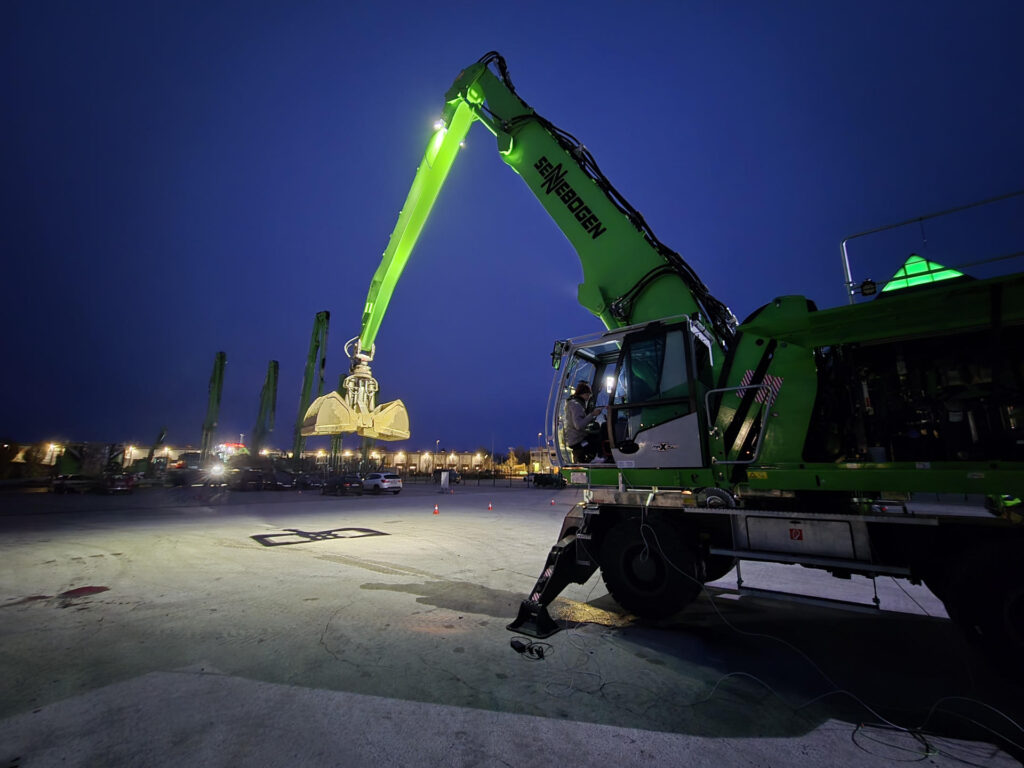
We built that path on a Sennebogen 830 G material handler: our solver and our engineers designed and built the teleoperation system end to end; Sennebogen brought the machine and the domain expertise.
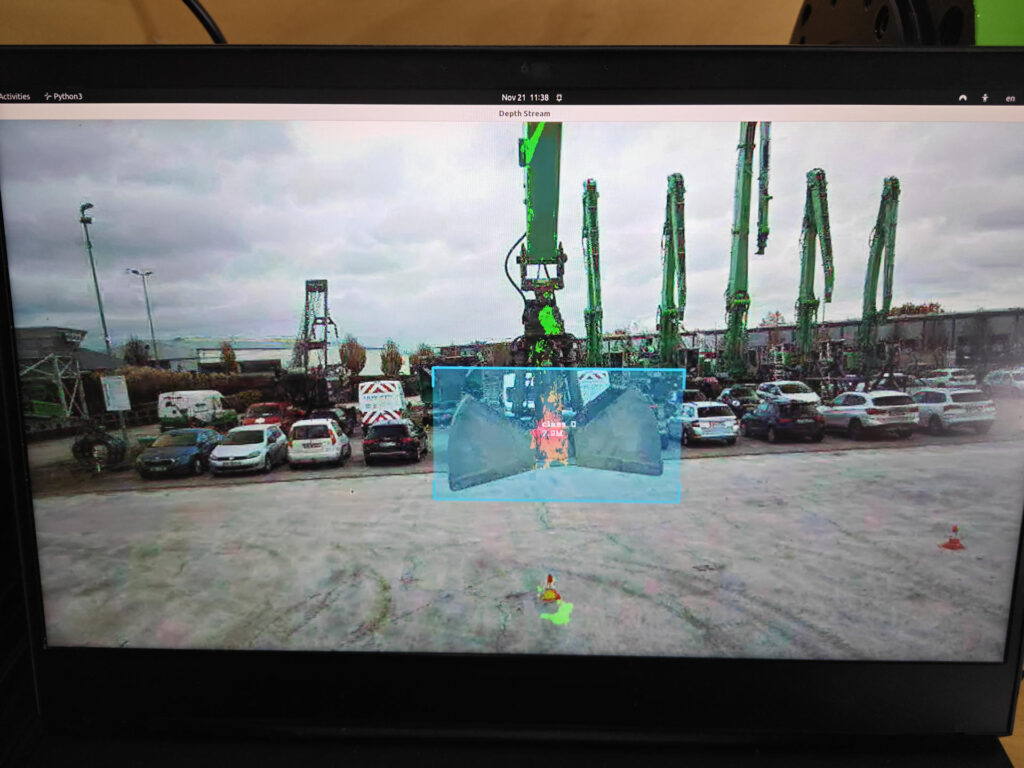
Making remote control usable for precise material handling is harder than streaming video. Flat camera feeds strip away the depth cues an operator relies on to position a grapple over a scrap pile or place a load on a truck bed. Without them, every movement is a guess, and a 17-meter reach turns small joystick errors into large ones at the grapple.
So we gave the operator a virtual shadow: a live 3D reconstruction of the implement and its surroundings, built from stereo cameras and AI-based depth and object detection running on edge compute mounted directly on the machine.
Under 100 milliseconds, end to end
Handling cycles are fast and continuous, so any lag between joystick input and machine response breaks the operator’s sense of control and turns precision work into overcorrection.
The compute platform reuses proven, cost-efficient hardware from the autonomous-driving world. But the depth reconstruction, the latency budget and the safety architecture on top are ours: our solver together with our engineers created them from the ground up. Reusing proven hardware is a deliberate choice that keeps the bill of materials realistic and lets the architecture scale beyond a single prototype machine.
Built to scale across machine types
Scaling was a design constraint from the start. The system is a machine-independent stack: sensors and edge compute in a self-contained cabinet, a standard fieldbus interface to the machine controls, and a remote station agnostic to what sits at the other end of the link. The material handler was the first application, but the same architecture carries over to crawler-mounted machines and to cranes, where the case for getting the operator out of the cab is often even stronger.
A working machine - and the first step toward autonomy
The immediate effect is a different working reality. The operator steps out of the hazard zone and into a safe, comfortable environment while keeping full control. And because control is no longer bound to a physical seat, one qualified operator can run equipment across multiple sites in a single shift instead of traveling to each one, turning a scarce skill into a far more productive resource.
The strategic effect matters more. Teleoperation is the first stepping stone toward full autonomy. Every machine equipped this way is networked, sensorized and AI-assisted from day one.
The near future of autonomy isn't the empty cab.
It's one operator running a whole fleet.